
Morrow County 72-Hour Release Status
The official Morrow County correctional page leads to a current JDS inmate roster. It does not lead to a rolling three-day release list. The JDS interface contains no archive, recent-release selector, or date-window filter, so it cannot display everyone who left during the requested period. Its Run Date/Time marks a present snapshot rather than the start or end of a 72-hour report.
A three-day release inquiry is still possible. It requires a bounded request and verification across the sources that record different parts of the event. Sheriff records can address physical exit and destination. Municipal or Common Pleas court records can explain bond, dismissal, sentence completion, probation, or transport. VINELink may report a participating custody change, while ODRC applies when the person entered Ohio prison custody or state supervision.
Check Morrow County 72-Hour Releases
Write down the exact beginning and ending dates before contacting an office. “The last 72 hours” moves each hour, while a request for named calendar dates is clear and reproducible. Ask for an existing release log covering that range, not a newly created analysis. Ohio public-record law generally requires an office to produce existing records rather than build a custom list.
- Review the current Morrow JDS roster. Save its Run Date/Time and the booking identifiers for any known person.
- Check the court named on the roster. Municipal Court handles the relevant misdemeanor and traffic path; Common Pleas CourtView provides the felony and general-jurisdiction path.
- Call the jail at 419-947-1151 when present physical status matters. Ask whether the person left, and distinguish release from agency transfer.
- Send the Sheriff a focused request for an existing release log or individual release record within the three-day dates. Ask for actual exit time, disposition, and destination.
- Use VINELink for a participating-agency event or alert. Search ODRC only if a state conveyance, judicial release, or APA status is plausible.
This workflow catches more than a same-day visual check. It also preserves the legal reason for the event. For a single recent date, the Morrow County 24-hour release process keeps the inquiry focused on the newest jail activity.
Note: Requesting existing records by precise calendar dates avoids ambiguity about when a rolling 72-hour interval began.
Morrow County Three-Day Release Fields
No official online three-day report was found, so a field list for such a feed cannot be invented. The table separates the fields visible on the current roster from the facts that should be requested in an actual release record. Together, they connect the correct booking to the exit event without treating a projected value as final.
| Field | How it helps a 72-hour inquiry |
|---|---|
| Run Date/Time | Fixes the time of the current roster snapshot. |
| Jail ID or SID | Links a name to the correct local booking. |
| Name and book date | Helps identify a row and set the date range. |
| Charge, court, case context | Routes the inquiry to the docket that may explain the legal action. |
| Current disposition | Provides a live label that must be checked against the journal entry. |
| Displayed Release Date | May be future-facing and therefore projected, not proof of exit. |
| Actual release date and time | Requested jail field that places the physical exit inside or outside the range. |
| Release reason or destination | Distinguishes community release from transfer to another agency. |
Keep the source URL and access date with each copied field. Dynamic rows can change, and not every source displays all identifiers. Exact spelling, birth date or age when shown, booking number, court, and case number help prevent a similar-name mismatch.
Morrow County Weekend Release Checks
A three-day range often crosses a weekend. That wider frame is useful because the roster has no published release-feed cadence and the Sheriff’s records request hours are weekdays. An event can occur while routine records-office service is closed, then require follow-up on the next business day. The live roster may also update between a person’s physical exit and the later records inquiry.
Do not infer a holiday or weekend policy that the Sheriff has not published. Instead, record what each source showed and when. The court docket may contain a release-authorizing order, but it may not show the precise jail-door exit time. A phone response can help with current status. The durable result is the jail’s event entry paired with the court action, especially where timing is disputed.
Morrow County Release Roster Quirk
Morrow’s most important data quirk is the “Release Date” column on the current roster. A person still shown in custody may have a future date there. The field can therefore be scheduled or projected. It cannot safely be counted as a completed release during a three-day window until the jail event or another authoritative source confirms that the person physically left.
The opposite inference is unsafe too. A blank date does not prove that someone will remain in custody, and disappearance does not prove community release. Morrow County releases can involve bond, recognizance, dismissal, time served, sentence expiration, or supervision. Departures can also involve transport to ODRC, transfer to another county, or another sovereign. The qualifier and destination decide which description is accurate.
The official current roster makes the local field arrangement visible.
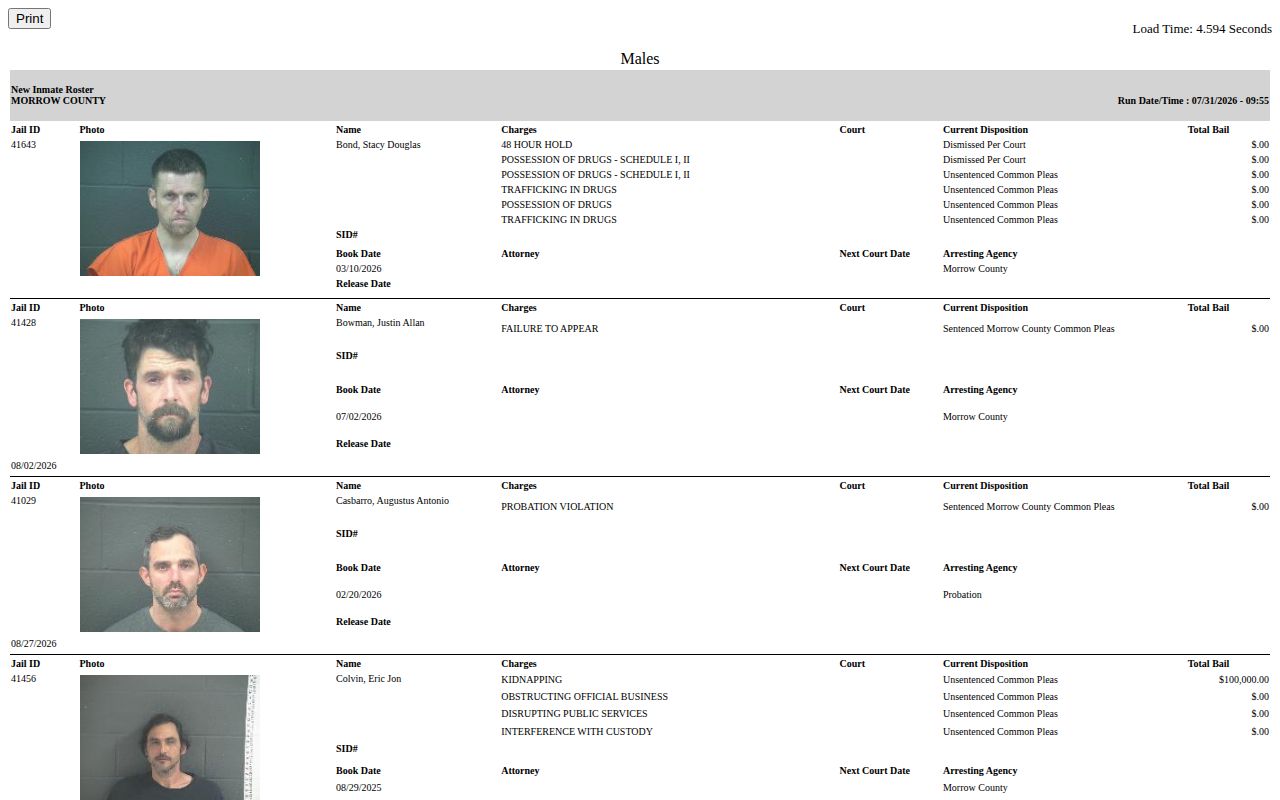
The screenshot should be read as a current-custody lead with a displayed run time, not as a three-day release archive.
Note: No published retention period states how long a departed booking remains visible after a Morrow County release.
Request Morrow County Release Records
A focused records request can cover either one person or an existing log for the selected dates. For a person, give the full name, approximate booking and release dates, Jail ID or SID when known, arresting agency, court, and case number. Ask for the booking or intake record, actual date and time of physical exit, release disposition, court or bond authority, and destination or receiving agency.
The Sheriff’s published in-person and email request hours are 8 a.m. to 4 p.m. Monday through Friday, excluding county holidays. Requests may be directed to the records office at 101 Home Road, Mount Gilead, Ohio, or reports@morrowcountysheriff.org. The administration and records telephone is 419-947-4845. The office may apply exemptions or redactions, and not every requested field is guaranteed to exist or be public.
Morrow County Sheriff Records
101 Home Road
Mount Gilead, Ohio
419-947-4845
Weekdays, 8 a.m.–4 p.m., except county holidays
Resolve Morrow County Release Conflicts
Sources can disagree because they answer different questions. The roster describes listed custody as of its run time. A court journal explains legal authority. A VINE alert reports an event supplied by a participating agency. ODRC describes Ohio prison or APA status. The jail release entry records the local physical exit. Compare each source’s timestamp, identity fields, agency, and status qualifier before deciding that a release occurred within the three-day period.
If a person is absent from the county roster but appears in ODRC as incarcerated, the likely event is a state conveyance, not community release. “APA Supervision” or “Judicial Release” means a state-controlled status that needs its full release detail. For federal sentenced cases, use BOP. For immigration or federal pretrial cases, the federal docket, holding facility, ICE, or USMS route may be required. A named-person search across these systems is laid out on the Morrow County released-inmate search.
When no source returns a match, keep the finding neutral. An old case may be sealed, a name may be indexed differently, or the person may belong to a custody system outside the one searched. Repeat the identity check with the known Jail ID, case number, date range, and agency before asking the records office to search. A negative online result is not proof that no Morrow County release record exists.
- Lead
- A roster date or missing row that points to more checking.
- Corroborating evidence
- A court summary or VINE event that supports a change.
- Authoritative event record
- The jail’s actual release entry, or the qualified ODRC status paired with the controlling order when needed.