
ODRC Release Routes
No single Ohio prison is the fixed destination for every person sentenced from Morrow County. Placement and later transfers are state functions. Once Common Pleas orders prison conveyance and the person enters ODRC, the statewide agency becomes the source for the current institution, prison status, expected date, qualified release detail, and Adult Parole Authority supervision. The Morrow County jail record still proves the county-side handoff, but it cannot certify the later state discharge.
Leaving an ODRC institution has several meanings. A record may show RELEASED, APA Supervision, Judicial Release, or another parole or release detail. Judicial release moves a qualifying person from prison into supervision ordered by the sentencing court. Parole and post-release control place a person under the Ohio Adult Parole Authority. Some administrative released records are qualified as death. Each qualifier must be retained. The word released by itself does not prove an unrestricted return to the community.
| ODRC result | What it generally means | Next check |
|---|---|---|
| Incarcerated | Listed in an Ohio prison | Current institution and sentence detail |
| RELEASED | Prison custody ended, subject to the shown qualifier | Parole or Release Detail and court order |
| APA Supervision | Living in the community under state supervision | APA office and supervision dates |
| Judicial Release | Prison exit under sentencing-court authority | Morrow Common Pleas journal entry |
| Violator at Large | Alleged absconding while authority continues | ODRC detail and named APA office |
Search Morrow ODRC Releases
The ODRC Offender Search accepts last and first name, county of commitment, residential county, ZIP, status, next parole-board hearing month, and offender number. Offender numbers require an A, R, or W prefix. A last name can work alone, but broad or prefix-style name matching may return similar people. Confirm the offender number, committing county, docket, offense, admission, and sentence data before relying on a result.
For a Morrow County release, use this search sequence.
- Search the full name and, when known, the prefixed offender number. Use Morrow as the county of commitment to narrow the case.
- Select Released, then repeat with APA Supervision. A person can be out of prison while still subject to state reporting.
- Open the detail. Read Status together with Parole or Release Detail. Do not stop at the expected-release field.
- Match the Morrow County docket, offense, sentence date, jail-time credit, and judge against the Common Pleas record.
- If an APA office appears, contact that listed office for the supervision side. Use ODRC Central Records for permitted record questions.
The official ODRC search form shows the status, county, identifier, and parole-hearing filters available to the public.
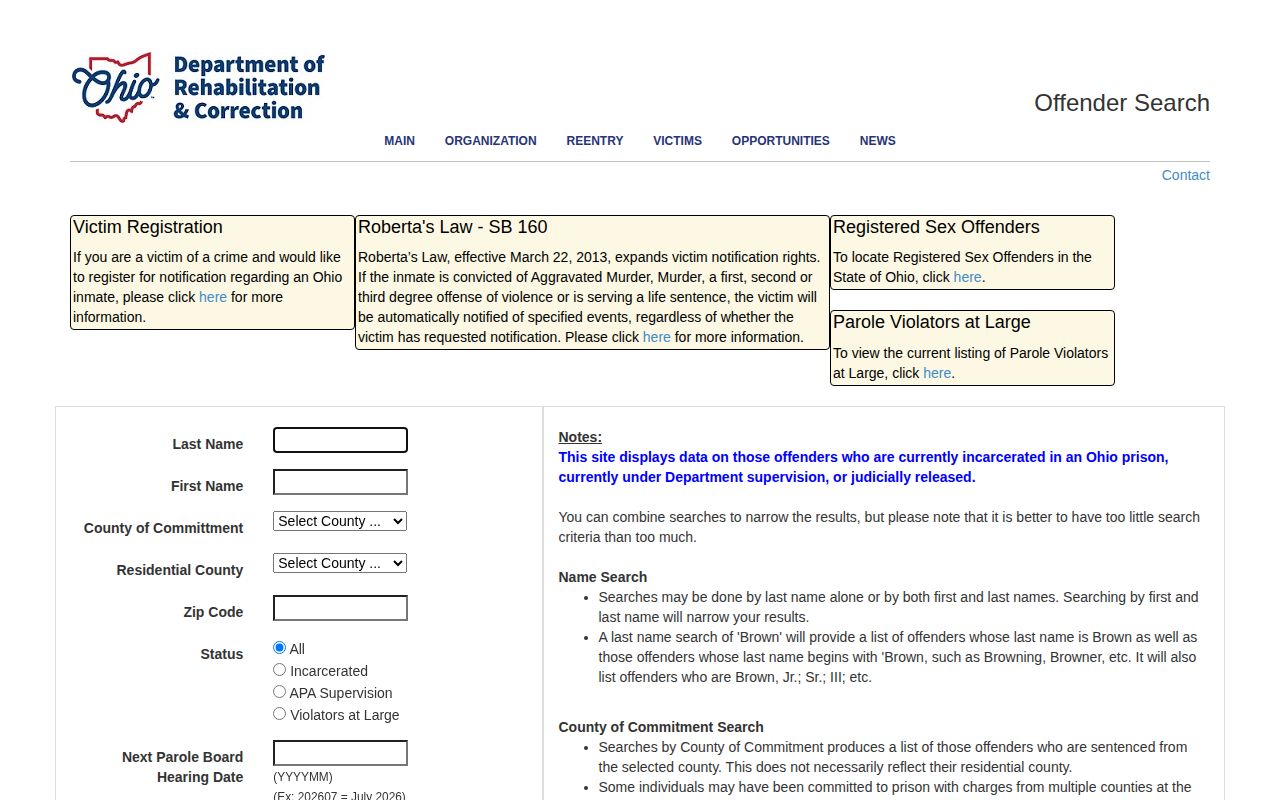
Those filters help separate an Ohio prison case from a jail-only Morrow County booking that never entered state jurisdiction.
ODRC Release Date Meaning
ODRC labels one field Expected Release Date/Parole Eligibility Date. Its official definitions say the field may be a projected release date or a date pending parole consideration. POA means the earliest release on APA supervision. PRD means Projected Release Date. A future Next Parole Hearing Date indicates review timing, not an approved exit. None of these values alone proves that a person actually left an institution.
An official example shows why the distinction matters. One detail can state RELEASED - Judicial Release while retaining a future expected date. In that situation, status, release detail, and the sentencing court's judicial-release order outweigh a simple reading of the future date. ODRC also demonstrates that RELEASED may be qualified as death. Accurate Morrow County release research preserves the exact status phrase instead of converting every result into the same outcome.
- Discharge
- The end of a custodial or supervisory term under the controlling record.
- Judicial release
- A prison exit granted by the sentencing court, usually with court supervision.
- Parole
- Conditional community release under Adult Parole Authority control.
- Post-release control
- A statutory period of APA supervision after prison.
- Expected date
- A projection or eligibility marker, not proof of actual exit.
Note: Save both the status qualifier and date label because a date without its field name can create a false release claim.
ODRC Release Record Fields
The public ODRC detail can show a photograph, offender number, name and descriptors, admission, institution, status, offenses and Ohio Revised Code sections, effective sentence date, jail-time credit, committing county, docket, judge, aggregate sentence, expected release or parole eligibility, release detail, and an APA office when applicable. Together these fields allow identity and case matching. They should not be reduced to a name and one date.
For a Morrow County case, the committing county and docket form a crucial bridge. Compare them to Common Pleas. Jail-time credit can also connect time spent at Morrow County Correctional Facility to the state sentence. An APA record may relate to a prior case rather than the new Morrow matter, so check dates, offenses, and court numbers. Similar names are not enough.
The official ODRC field definitions explain expected dates, release detail, APA Supervision, POA, PRD, judicial release, transitional control, and Violator at Large.
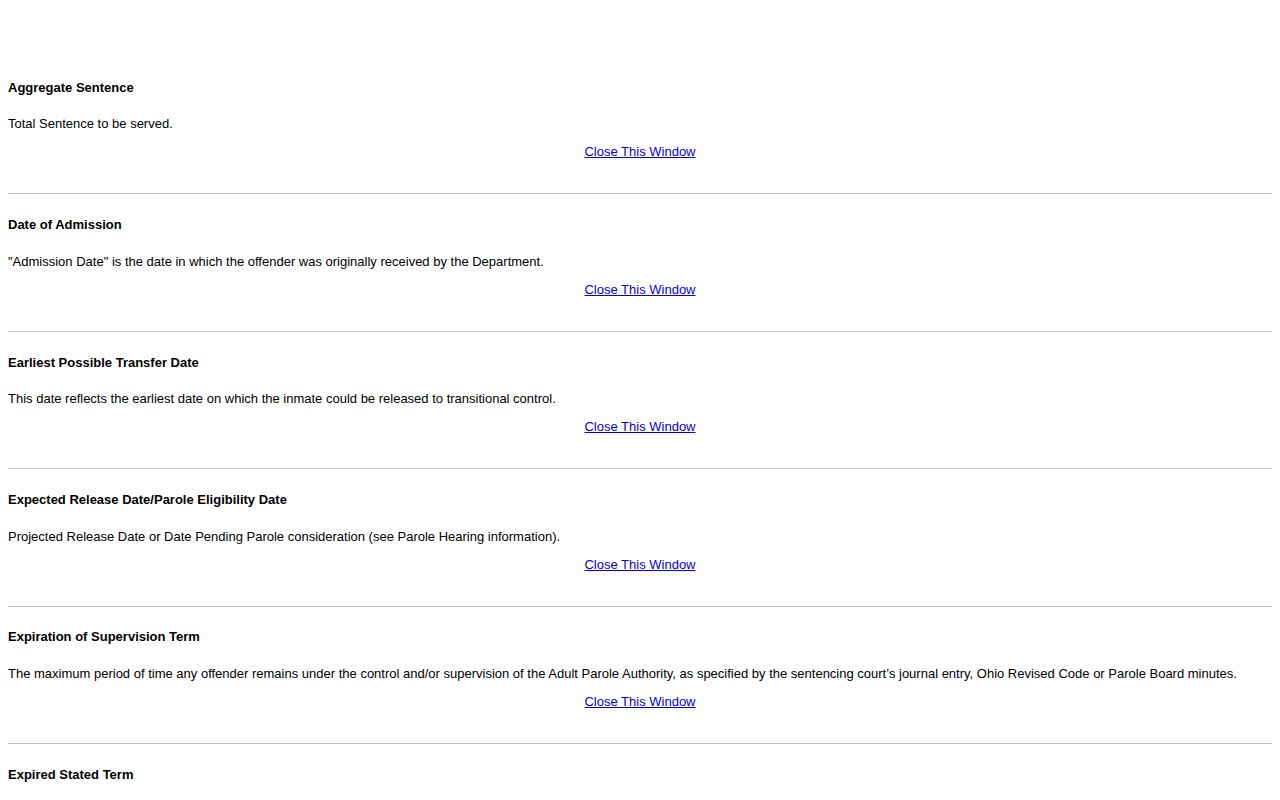
The definitions keep projected, supervised, and completed-release concepts separate when reading a Morrow commitment.
ODRC Release Records Contact
Ohio law does not make the entire inmate or APA file public. ORC 149.43 excludes those records except where disclosure is permitted through ORC 5120.21. That statute allows specified identifying, conviction, photograph, incarceration, discharge, and supervision information. OAC 5120-9-49 adds rules for public parole-board determinations, orders, minutes, and selected history. A request should identify the specific public fields sought rather than demand a complete institutional file.
ODRC Central Records
Mail: Attention Central Records
P.O. Box 430
Columbus, OH 43216
Scope: Publicly permitted ODRC release, discharge, and record questions
No authoritative current web form, email address, fixed photo fee, or guaranteed turnaround was confirmed for Central Records. Those details should not be inferred. Direct accuracy questions about a public offender detail to Central Records by the confirmed mailing route, and cite the offender number, Morrow docket, and exact disputed field.
A county Sheriff request covers the Morrow booking and transport to state custody. It does not cover the later ODRC prison discharge file. Conversely, ODRC can explain the state release but does not replace the jail's local handoff entry. The two records form a sequence when a person moved from local detention into prison.
Morrow ODRC Supervision Releases
The Ohio Adult Parole Authority is an ODRC division. Its public path is the same offender search, using APA Supervision and the release detail rather than a separate universal Morrow parole directory. Residential county and ZIP can help narrow supervision results. When the detail names an APA office, that office is the correct contact for current state reporting status.
Local probation is different. Municipal or Common Pleas community control arises from a local court and may not appear under APA unless a separate state case exists. A person can be physically released from the county jail, supervised by Morrow probation, and have no state-prison record at all. The Morrow County post-release supervision route distinguishes APA, Municipal Probation, and Common Pleas Adult Probation.
Verification should answer three questions separately: when confinement ended, which court or board authority allowed the change, and what supervision remains. ODRC status and release detail address the state part. The Morrow court journal supplies local authority where judicial release or community control is involved. A supervision record proves continuing authority, not the exact hour prison discharge was processed.
Resolve Morrow ODRC Conflicts
Dynamic sources can disagree. A Morrow roster may show a person gone while ODRC has not yet posted an admission. A court order may be entered before transport or discharge processing finishes. VINELink may lag a state feed. Preserve each source's timestamp and assign the question to the office that owns the event. The jail owns the county exit, Common Pleas owns its journal, ODRC owns prison and APA status, and the receiving institution owns its current custody record.
A negative ODRC search also has narrow meaning. The person may never have entered state jurisdiction, the spelling may differ, or the record may not match the filters. Search by offender number when possible, then by name and Morrow commitment. If the original matter was a short county sentence, return to Sheriff and court records. Do not turn the absence of a state result into proof of release.
Keep a small verification record: exact name, offender number, commitment county, docket, offense, admission date, status and qualifier, expected-date label, APA office, source URL, and access date. That set allows later readers to understand why the conclusion was reached even if a dynamic page changes.
Note: The strongest ODRC release finding combines a qualified status with matching identity, Morrow docket data, and the controlling court record.