
Morrow Court Release Process
Morrow County Municipal Court is a court process, not a separately documented long-term jail. Defendants who are physically detained are ordinarily booked at Morrow County Correctional Facility. The Municipal Court record supplies the case events. The jail record supplies the custody events. Keeping those roles separate prevents a court disposition from being mistaken for an exact exit timestamp.
The Municipal Court has countywide territorial jurisdiction for its covered misdemeanor and traffic matters. A person may leave detention after posting bond, receiving recognizance release, a dismissal, time served, sentence completion, or another journalized order. The case can remain active after bond release. Local probation can also begin while the person is out of jail. An end to physical custody does not always end the criminal case or court supervision.
Search Morrow Court Releases
The Municipal Court case-history entry is the first docket route for a misdemeanor or traffic matter. Use the exact name, case number when known, charge, and hearing information. If the live jail roster identifies Morrow County Muni as the court, preserve that label and the Jail ID before the row changes. A name-only match needs support from dates and case details.
Follow a short, source-specific sequence.
- Check the current Morrow JDS roster and record the displayed run time, exact name, Jail ID, court, charge, booking date, and disposition.
- Open the Municipal Court search for the matching name or case. Review the case history and locate the controlling journal entry.
- Identify whether the event was bond, recognizance, dismissal, sentence credit, sentence completion, probation, or another order.
- Call the jail when same-day physical status matters. Ask whether the person left the county facility or was transferred.
- Request the existing Sheriff release entry for the actual date, time, disposition, destination, and authority when a durable record is needed.
The official Morrow County Municipal Court search screen provides the local criminal and traffic case-history entry.
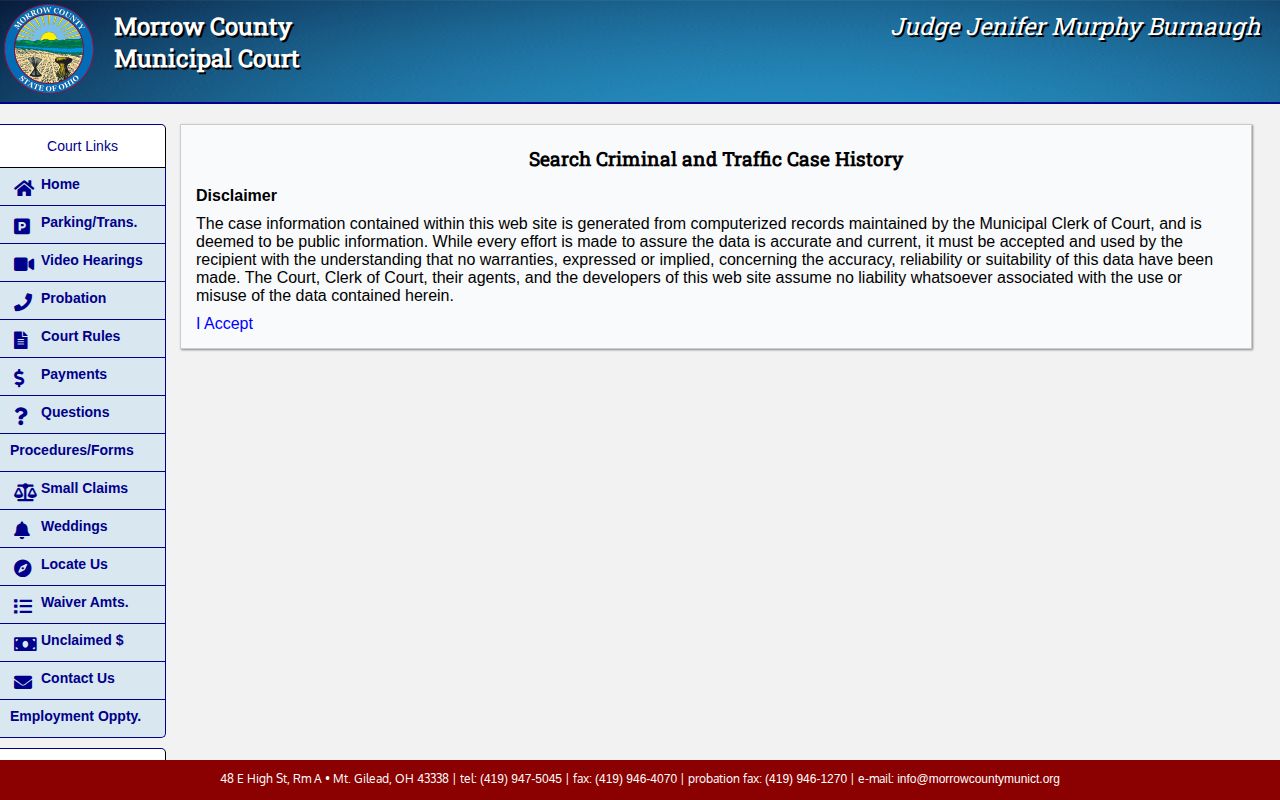
This court source should be read with the jail's physical-release entry, especially when exact departure time or transfer destination matters.
Note: Search Common Pleas CourtView instead when the roster or charge identifies a felony or general-jurisdiction case.
Morrow Court Release Entries
The docket may preserve bond setting or modification, recognizance release, dismissal, plea and finding, sentence, jail-time credit, sentence completion, probation or community control, revocation, and termination. These entries remain useful after a live booking disappears. They show the legal reason a Morrow County hold ended or changed. They may also show that a case continues even though the person is no longer confined.
Read the final or controlling journal entry rather than a brief summary label. A dismissal in one case does not rule out another warrant, case, sentence, or hold. A bond order does not prove the jail completed release processing. Jail-time credit helps explain a time-served result but does not supply an exit timestamp. Each item is evidence of authority, not a substitute for the facility's own event record.
| Court entry | What it may explain | What still needs confirmation |
|---|---|---|
| Bond or recognizance | Authority to remain out while the case proceeds | Actual jail discharge and other holds |
| Dismissal | That case no longer supports custody | Other cases, warrants, or transfers |
| Time served | Sentence and credited time | Physical release processing |
| Probation | Community control under the court | Reporting office and start status |
| Completion or termination | End of a sentence or supervision event | Any separate active authority |
Morrow Court Physical Release
Morrow County Correctional Facility is the physical custodian for an ordinary local detention. Its live roster is current-custody evidence at the displayed run time. It is not a released-person archive. A future value in the roster's Release Date field can be scheduled or projected. Likewise, disappearance can mean community release, transfer, data correction, or another agency's custody. Neither condition proves the completed outcome alone.
For the strongest result, pair the Municipal Court authority with the Sheriff's actual release entry. Ask for the full name, Jail ID or SID, approximate booking date, charge, court case number, actual release date and time, disposition, destination, and the order or bond record that authorized it. If another agency received the person, call it a transfer and continue with that agency.
The Morrow County Correctional Facility release route explains the jail call, records request, and transfer checks in depth. The jail telephone is 419-947-1151, while Sheriff records administration uses 419-947-4845. Staff may limit telephone disclosure, so a focused records request is the durable route.
- Journal entry
- The court's formal written record of an order or case event.
- Recognizance
- Release based on a promise to appear rather than cash bond.
- Community control
- Ohio court supervision in the community, often called probation.
- Remand
- An order returning a person to custody.
- Discharge
- The documented end of a custody or supervision term.
Morrow Court Release Contacts
The Municipal Court can assist with its case record, hearing history, and journalized orders. It cannot replace the Sheriff's physical-custody log. Direct a docket question to the court and a departure-time question to the facility or records office. This division also helps avoid asking court staff to certify an event owned by the jail.
Morrow County Municipal Court
Address: 48 E. High Street, Room A
Mount Gilead, OH 43338
Telephone: 419-947-5045
Email: info@morrowcountymunict.org
For the Sheriff record, requests are accepted in person at 101 Home Road and through reports@morrowcountysheriff.org during posted hours of 8 a.m. to 4 p.m. Monday through Friday, except county holidays. Ohio's Public Records Act calls for prompt inspection and copies within a reasonable period after review and redaction. No fixed completion deadline should be promised.
Request existing fields. The office does not have to answer questions or create a new report. Ask for public portions and the legal basis for any redaction. Online disappearance is not a retention rule, so provide an approximate range, full identity details, Jail ID if known, and the Municipal Court case number for an older event.
Morrow Court Probation Release
A Municipal Court release can lead into local probation, also called community control. That status differs from ODRC parole or post-release control. The official Municipal Probation page says reporting is generally in person at least monthly, uses a kiosk on the courthouse's top floor, and requires changes of address, telephone, or name to be submitted in writing. Its telephone is 419-947-5512.
The court docket should show the sentence and supervision order. The probation office can confirm the correct local reporting route where disclosure is appropriate. Do not search ODRC as the default for a misdemeanor probation case unless a separate state-custody or APA basis exists. Common Pleas Adult Probation handles felony community control, so the roster court and docket must guide the choice.
The key questions stay separate. Did the person leave Morrow County Correctional Facility? What order allowed the release? What supervision remains? The Sheriff, Municipal Court, and Municipal Probation each own one part. A probation record is evidence of community supervision, not proof of the hour that jail discharge finished.
Note: Municipal Probation and the Ohio Adult Parole Authority are separate systems, even when both supervise someone after confinement ends.
Older Morrow Court Releases
For an older event, start with the court case number and booking identifiers, then request the Sheriff's retained record. A dynamic portal may no longer expose every old entry. Sealing or expungement can also change ordinary public access. Under Ohio law, eligible conviction, dismissal, no-bill, not-guilty, and pardon records follow different relief paths. An empty search should therefore remain a neutral finding.
Retention cannot be inferred from how long a roster row or court screen remains visible. Public records follow approved schedules. A focused request should name the exact existing records needed and include an approximate date range. If a court relief order limits access, the office must follow that order and other exemptions. Protected personal, juvenile, medical, victim, and active-investigation material may be withheld or redacted as law allows.
When sources conflict, retain both timestamps. A judge can order release on one date while the facility processes discharge later. Report the court order and jail exit as separate events. If the disposition is Out Of County, ODRC conveyance, or another transfer, continue with the receiving system. Sending-county roster removal does not prove community release.
Morrow Court Release Limits
Municipal Court is the right source for its own misdemeanor and traffic case authority. It is not a statewide prison locator, a federal custody system, or a physical release log. A person sentenced to ODRC belongs in the state offender search after conveyance. A federal pretrial matter belongs with the federal docket and U.S. Marshals custody path. Immigration detention uses ICE channels.
A sound Morrow County finding states what each record proves. The live roster is a current snapshot. The Municipal Court journal explains an order. The Sheriff's exit record supplies the physical event. Probation confirms local supervision. Keep names, case numbers, booking identifiers, dates, disposition words, source run times, and access dates so the result can be checked later.
The best conclusion is often qualified. “The Municipal Court ordered release, and the Sheriff record shows physical discharge” is stronger than “the person vanished from the roster.” If only the order is available, say so. Precision respects both the record and the person it concerns.