
Morrow County Projected Release Dates
A projected or scheduled date is an estimate based on facts known at the time. An actual release date records a completed custody event. Morrow County's live JDS roster makes this distinction especially important. Some people still listed in current custody can have a future value under Release Date. That field can therefore be scheduled or projected. It is not proof that anyone has left the Morrow County Correctional Facility.
Pretrial cases often have no reliable set date. Release may turn on bond, recognizance, dismissal, a plea, a court order, or a hold from another agency. A sentenced county prisoner may have a computation, but the jail and court records must show how sentence length and jail-time credit were applied. Use the Municipal case history for the misdemeanor path and Common Pleas CourtView for the felony path. Someone conveyed to an Ohio prison has entered a different system. ODRC fields and state law then control.
| Displayed information | What it can establish | What it cannot establish |
|---|---|---|
| JDS Release Date | A scheduled date shown on a current booking row | That physical release already occurred |
| ODRC Expected Release Date/Parole Eligibility Date | A projected release or date pending parole review | A guaranteed exit on that day |
| Court journal entry | The legal authority, sentence, bond, or judicial action | The exact time jail discharge processing ended |
| Actual jail release entry | The physical exit date, time, and disposition if recorded | Another agency's later custody status |
Lookup Morrow County Release Dates
The right lookup starts with custody type. A local booking remains a Sheriff and Morrow court matter unless the person was transported elsewhere. A state-prison commitment belongs in ODRC. A federal sentenced prisoner belongs in the BOP locator, while immigration custody uses ICE channels. One portal cannot prove release from every system.
- Check the Morrow JDS current roster. Note its run time, Jail ID, court, current disposition, booking date, and any future release value.
- If the case is local, read the matching Municipal or Common Pleas docket. Look for bond, sentence, jail-time credit, dismissal, transfer, or another controlling entry.
- Call the Morrow County Correctional Facility at 419-947-1151 for urgent same-day status. Ask whether the date is only scheduled and whether any hold or transfer applies.
- For an Ohio prison case, use the ODRC Offender Search. Match the offender number, committing county, docket, sentence, and release detail.
- Read the precise ODRC field Expected Release Date/Parole Eligibility Date with the status and sentence type. Do not isolate the date.
- Use the relevant jail, court, or ODRC records route to confirm the actual completed event. A VINE inmate check can supply a reported custody alert from a participating feed.
An absent name is not an answer. A jail removal may mean community release, transfer to another county, conveyance to ODRC, or another sovereign's hold. An absent ODRC result may simply mean the person never entered state prison. Match the system before treating a negative result as meaningful.
Note: When a durable date is needed, ask for the existing record rather than requesting that an office create a new calculation.
ODRC Morrow County Date Fields
ODRC Offender Search covers people incarcerated in Ohio prisons, under Department supervision, or judicially released. Searches accept first and last name, county of commitment, residential county, ZIP, status, next parole-board hearing month, and an offender number with its A, R, or W prefix. A Morrow County jail-only case may never appear.
The exact date label is Expected Release Date/Parole Eligibility Date. ODRC defines it as either a projected release date or a date pending parole consideration. The abbreviations matter. POA is the earliest release on APA supervision. PRD means Projected Release Date. A future next-hearing value means the board review is ordinarily conducted about two months before the displayed month.
Official details demonstrate why the full line must be read. One ODRC example shows RELEASED - Judicial Release while retaining a later expected date. Another official record can code release as death. Thus the word Released alone does not say the person returned to the community, and the expected date alone does not say the person remains confined.
The ODRC field definitions show the terms used in Ohio release-date records.
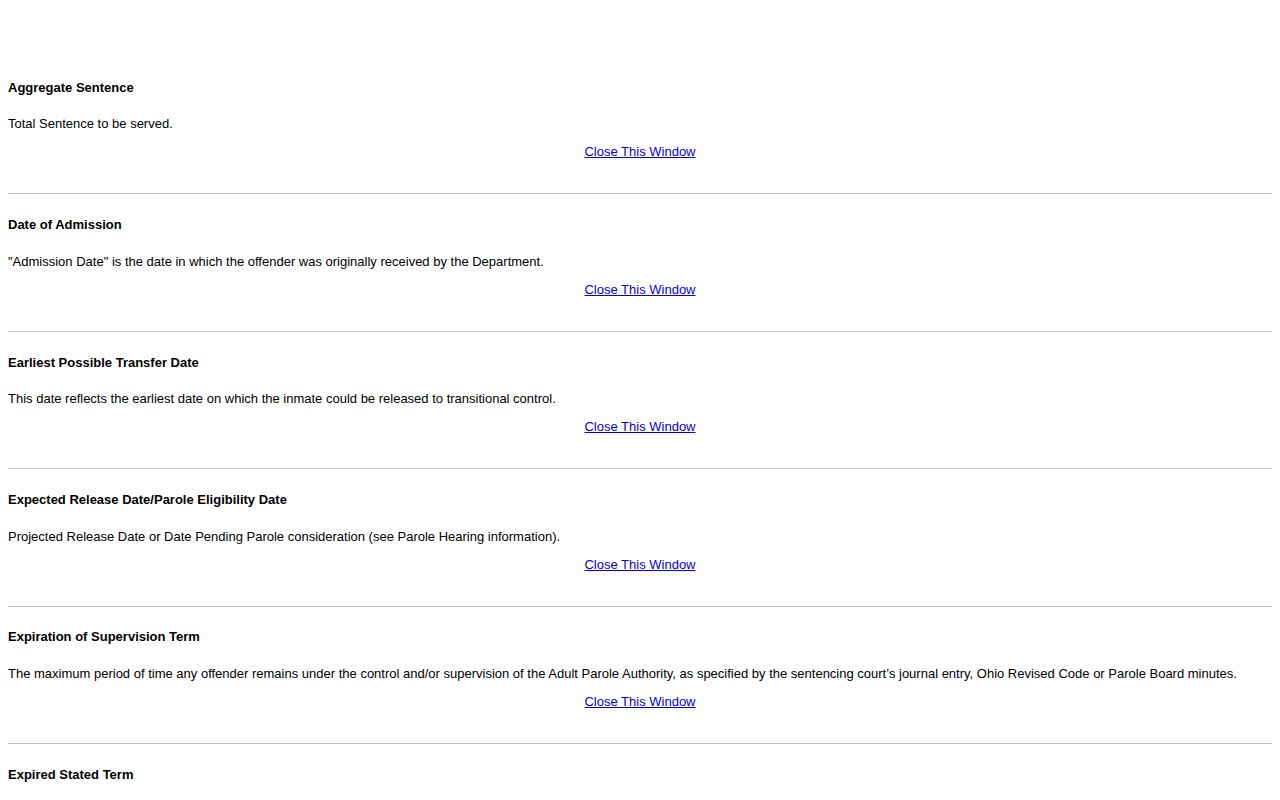
Those definitions make status, parole detail, expected date, judicial release, and APA supervision part of one reading task.
Ohio Earned Credit Dates
Ohio's current productive-program credit rule is specific, not a blanket promise. ORC 2967.194 applies to confinement on or after April 4, 2024. Eligible people may provisionally earn one or five days per completed month for productive program participation. Completing a second program can yield up to five more days in that month. Some qualifying completions yield 90 days or ten percent of the stated term, whichever is less, per qualifying completion.
Except for that separate completion category, the aggregate participation and completion credit cannot exceed fifteen percent of the stated term. ODRC records credit monthly and may deny or withdraw it for violations. Numerous sentences are excluded, including specified mandatory terms, murder and aggravated-murder sentences, death sentences, life without parole, certain ORC 2971.03 terms, and specified sexually oriented offenses. OAC 5120-2-06 distinguishes the current and older credit systems.
It is inaccurate to say every Ohio prisoner must serve 85 percent. That figure comes from the ordinary fifteen-percent credit cap in a qualifying case. Mandatory time, exclusions, sentence era, separate completion credits, jail-time credit, judicial release, transitional control, parole, and indefinite sentencing can all alter the result. The statute and sentence record control.
- Jail-time credit
- Qualifying time already spent in confinement that a court credits toward a sentence.
- Earned credit
- A conditional reduction recorded under the applicable Ohio statute and ODRC rules.
- Mandatory term
- A portion of a sentence that applicable law requires to be served.
- Judicial release
- A court-authorized move from prison to court-controlled community supervision for an eligible person.
Morrow County Indefinite Sentence Dates
Qualifying non-life felony indefinite sentences require more than a single subtraction. ORC 2967.271 generally presumes release at the minimum term or presumptive earned early release date, whichever is earlier. ODRC may rebut that presumption after a statutory hearing and retain the person, though not beyond the maximum term.
A director recommendation and court action may reduce the minimum by the statutory percentage when the person qualifies. That creates several distinct concepts: minimum term, maximum term, presumptive release, presumptive earned early release, expected release, and actual release. None should be collapsed into one fixed date on a Morrow County record.
Parole-eligible life terms follow other law. ORC 2967.13 has sentence-specific eligibility rules and exclusions. A displayed parole-eligibility date means the board may consider release under the applicable framework. It is not a promise that parole will be granted.
Why Morrow County Dates Change
A projected date changes when one of its inputs or legal controls changes. Some corrections are favorable, while others can delay release. The cause should be traced to the court order, ODRC record, board minute, facility calculation, or receiving agency.
| Change factor | Possible effect | Where to verify |
|---|---|---|
| Jail-time credit correction | Moves the computed end date | Sentencing entry and jail computation |
| Earned credit awarded | May move an eligible date earlier | ODRC sentence and credit record |
| Credit denied or withdrawn | May move a projected date later | ODRC record under the applicable rule |
| Consecutive or concurrent terms clarified | Changes aggregate sentence length | Court journal and ODRC detail |
| Judicial release | Can produce a completed prison exit before an old expected date | Court order and ODRC release detail |
| Parole-board action | May grant, deny, continue, keep, accelerate, or rescind a PRD | ODRC detail and official minutes |
| Detainer or agency hold | May prevent community release or cause transfer | Facility record and receiving agency |
A detainer is a request or legal basis for another authority to take custody. The person can leave one facility without being released to the community. This is why Morrow roster removal and an ODRC or federal transfer must be described as custody changes until records establish the destination.
Note: A projected date can remain visible after an earlier judicial release, so current status and release detail take priority over the old estimate.
Confirm Morrow County Actual Release
For a county event, ask the Sheriff for the actual date and time the person physically left the Morrow County Correctional Facility. Include the full name, approximate booking date, Jail ID or SID if known, arresting agency, charge, and court case number. Request the release disposition, destination, and the bond, court order, sentence-expiration record, or transfer document that authorized the event.
The Sheriff records office accepts requests at 101 Home Road, Mount Gilead, and through reports@morrowcountysheriff.org during its published weekday hours. The policy promises prompt inspection or copies within a reasonable time after review and redaction, not a fixed number of days. Call records administration at 419-947-4845 if the two sheriff email domains seen on different pages create doubt.
For a state case, read the ODRC status and parole or release detail, then compare the Morrow committing county and docket. ODRC Central Records can address public release and discharge fields at P.O. Box 430, Columbus, OH 43216. The complete institutional or APA file is not generally public, but specified conviction, photograph, incarceration, discharge, and supervision information can be disclosed under Ohio law.
Final proof is event-based. A court order provides authority. A facility release record supplies physical exit. ODRC supplies state status and release detail. A receiving agency establishes transfer custody. When those sources conflict, note their timestamps and ask the office that created the later record. Preserve the exact label and query date with the result. That small audit trail shows whether an expected date was read before or after a later court or board action. It also prevents a stale screen capture from outweighing a newer official release entry.